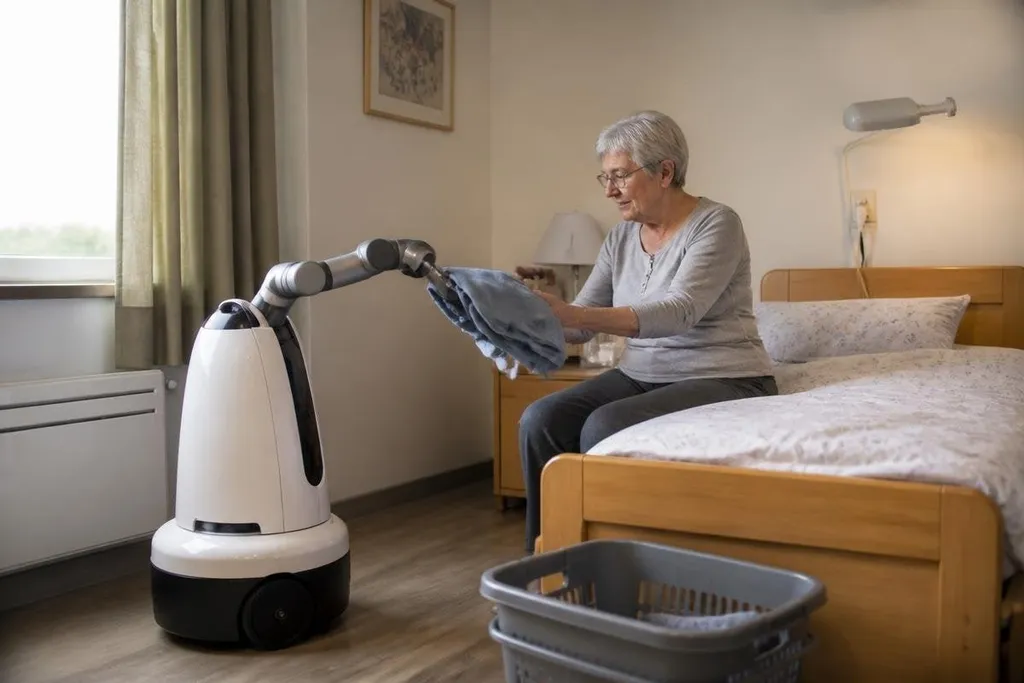
A care robot does not need to look human to help someone at home or in a care facility. It needs to handle one useful task safely, explain what it is doing, and stop when a person asks it to stop.
The next wave of caregiving robots will be judged by daily work rather than polished demonstrations. That puts the focus on narrow jobs, clear limits, and the staff who must keep the system running.
- One clear job: carrying supplies, checking rooms, or helping with a call for assistance.
- Human control: a person can pause, redirect, or shut down the robot without special training.
- Proof in the workplace: the robot fits existing care routines instead of adding more screens and alerts.
Care work is a set of small tasks
Caregiving includes many jobs that look simple until a robot has to do them around people. A system may need to move through a narrow room, carry an uneven load, avoid a walking person, or place an item where a hand can reach it.
That makes a single-purpose robot easier to assess. A mobile platform that carries clean laundry has a clear route, payload, and handoff point. A robot that claims to support every part of care has far more ways to fail, and each failure can affect a person who may have limited movement or memory.
The useful question is not whether a robot can move. It is whether the task still works when the floor is crowded, the lighting changes, or a person leaves an object in the robot’s path.
Sensors do the work, but people set the rules
Care robots may combine cameras, microphones, LiDAR, and force sensors. LiDAR measures distance with light, helping a mobile robot build a map and avoid nearby objects. Force sensors can tell the robot when a hand, blanket, or door pushes against it.
Sensors do not decide what care should look like. That part belongs to people.
The care worker needs controls that show the robot’s location, current task, battery state, and reason for stopping. The system also needs a clear way to report a failed delivery or a blocked route.
Privacy adds another limit. Cameras and microphones can collect details about health, routines, visitors, and private conversations. A care provider should know what data the robot stores, how long it stays there, and who can view it before the first unit enters a resident’s room.
A privacy policy matters only if staff can work with the robot without extra steps. Reports on care robotics at Robot24.com can show where alerts go and how the robot fits a care team’s daily work.
The staff workflow matters more than the demo
The robot only helps when it fits the shift. If a worker must clear a route, reset the robot, refill its supplies, and answer several false alarms, the task may take longer than carrying the item by hand.
Training needs the same care. Staff should learn how to pause the robot, move it safely, report a fault, and recover after a network or power failure. Residents need a plain explanation of the robot’s purpose and a visible way to decline contact.
Remote control can cover unusual cases, but it changes the labour involved. A person may need to guide the robot around a blocked doorway or help it identify the correct room. That work should appear in the operating plan instead of being treated as a rare exception.
What remains unproven
Many care tasks involve touch, judgment, and trust. Helping someone stand, wash, dress, or move from a bed to a chair brings safety risks that a delivery robot does not face. A machine may sense contact without understanding pain, fear, or a change in balance.
The same limit applies to conversation. A robot can read a scripted prompt or connect a resident to a family member. That does not make it a caregiver, and it should not replace human contact where a person needs judgment or comfort.
I'd reject any care robot whose plan depends on residents adapting to poor controls or staff hiding failures from management. A safer purchase starts with one task, a named owner, and a record of every stop.
A practical check before buying
Use this list when a supplier presents a care robot for a pilot:
- Name the task: write down the start point, destination, load, handoff, and person responsible.
- Watch a full shift: include busy corridors, low light, blocked routes, charging, and a fault report.
- Ask for the stop plan: check who can pause the robot and how quickly it becomes safe.
- Review the data path: list every sensor, stored file, access role, and deletion period.
- Count staff minutes: record setup, cleaning, charging, remote help, and recovery time.
- Set a pass mark: decide the error rate, response time, and resident feedback needed to continue.
The best first deployment may look modest: one robot, one route, one task, and a human nearby. If that work stays safe and useful across real shifts, the next task has a reason to exist; if it does not, the trial has still answered the buying question.